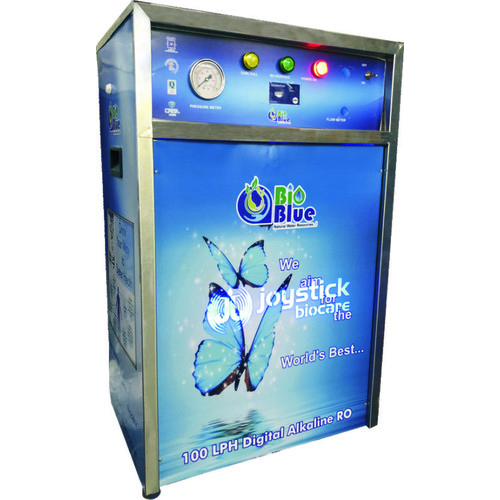
Industrial RO (reverse osmosis) systems are large-scale water filtration systems designed for industrial applications that require large quantities of purified water. These systems use a multi-stage filtration process that includes sediment filters, activated carbon filters, and reverse osmosis membranes to remove impurities and contaminants from the water. Industrial RO systems can process large volumes of water, ranging from several hundred to thousands of gallons per day, depending on the size of the system. The purified water is then stored in a large tank for distribution to various industrial applications such as manufacturing processes, food and beverage production, and agriculture. Industrial RO systems are designed for heavy-duty use and typically include features such as automatic shut-off valves, pressure gauges, and pre-treatment options to optimize performance and extend the life of the system. It is important to properly maintain and regularly service the industrial RO system to ensure its effectiveness and safety.
Cutting-edge Purification for Industrial NeedsEngineered for rigorous demands, these Reverse Osmosis systems use polyamide thin film composite membranes to deliver reliable, high-purity water. Their robust, continuous operation ensures performance even under heavy workloads, making them ideal for factories, pharmaceuticals, and process industries requiring consistent water quality.
Engineered for Efficiency and LongevityThe system's high recovery rate of 50-70% maximizes output while reducing waste. Integrated PLC controls, digital meters, and automatic flushing streamline operation and maintenance. These features, combined with durable materials and advanced prefiltration, significantly extend membrane service life.
Customizable and Fully Automated SolutionsIndustrial RO units are available with customizable capacities and dimensions, suitable for varied space requirements and production volumes. Skid-mounted, they allow hassle-free installation, while automatic features like TDS control and membrane cleaning help minimize manual intervention and lower operating costs.
FAQ's of Industrial Ro Systems:
Q: How does the polyamide thin film composite membrane improve purification in industrial RO systems?
A: Polyamide thin film composite membranes are designed for superior salt rejection and effective removal of dissolved solids, microbes, and contaminants. Their structure enables high flow rates and consistent, high-purity water output, making them particularly suitable for demanding industrial applications.
Q: What is the typical process flow in an industrial RO system with this specification?
A: Feed water first passes through multi-stage prefiltration (sand and cartridge filters) to remove larger particles. It is then pressurized by a high-pressure centrifugal pump before entering the RO membrane. The system, often PLC and sensor-controlled, separates purified water from salts and contaminants, with automatic flushing ensuring optimal membrane performance.
Q: Where are industrial RO systems commonly installed and used?
A: These systems are widely employed in factories, hospitals, food processing plants, textile manufacturing, pharmaceuticals, and other settings in need of large-scale, reliable water purification in India. Their customizable size and performance make them adaptable to various industrial and commercial environments.
Q: When should the RO membrane or filters be replaced?
A: RO membranes generally have a service life of 2-3 years, depending on water quality and system usage. Pre-filters, such as sand or cartridge filters, may require more frequent replacement, typically every 3-6 months, to maintain efficiency and protect the membrane.
Q: What advantages do these industrial-grade RO systems offer over conventional filtration?
A: With advanced membranes, high-pressure pumps, and automatic operation, these systems deliver higher contaminant and salt removal rates. Features like PLC-based control, digital monitoring, TDS adjustment, and self-cleaning reduce manual intervention, lower maintenance costs, and ensure consistent water quality.
Q: How is the system installed and maintained?
A: Installation is straightforward due to the skid-mounted, modular design and customizable dimensions. Maintenance is simplified by automatic flushing, self-cleaning functions, and easily accessible cartridge/sand filters. Regular monitoring of digital meters and periodic filter changes are recommended for optimal system performance.
Q: What is the electricity consumption and noise level during operation?
A: Electricity consumption varies by model and capacity, generally ranging from 2 to 7 kWh. The systems are engineered for low noise, making them suitable for environments where minimal disturbance is essential.