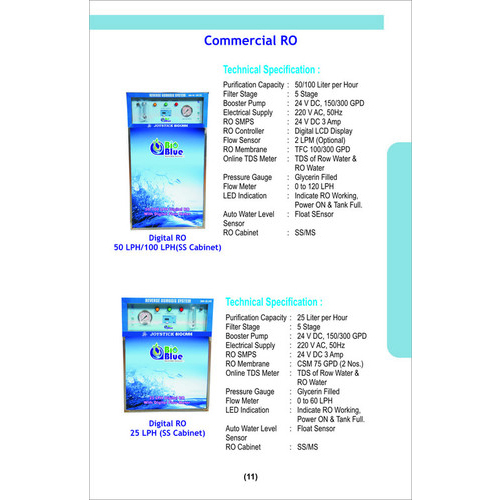
Commercial RO (reverse osmosis) system is a type of water filtration system designed for larger-scale applications such as commercial buildings, restaurants, and industrial facilities. The system works in a similar way to a domestic RO system, using a semi-permeable membrane to remove impurities and contaminants from water. However, a commercial RO system is typically larger and more complex, with multiple stages of filtration and a higher capacity for water treatment. The system may include pre-filters to remove sediment and other larger particles, a carbon filter to remove chlorine and other organic compounds, and a reverse osmosis membrane to remove dissolved minerals and contaminants. The purified water is typically stored in a large tank and distributed through a network of pipes or dispensers. Some commercial RO systems may also include additional features such as a UV sterilizer to kill bacteria and viruses, a deionization stage to remove minerals and dissolved solids, and a water softener to prevent scale buildup. It is important to choose a commercial RO system that is appropriate for the specific application and to follow the manufacturer's instructions for proper installation, use, and maintenance to ensure optimal performance and water quality.
Advanced Five-Stage FiltrationThe commercial RO system features a comprehensive five-stage purification process, including Reverse Osmosis, Ultraviolet (UV), Ultrafiltration (UF), and TDS control. This multi-layered approach ensures thorough removal of particulates, dissolved salts, microorganisms, and suspended impurities, delivering water that meets stringent commercial quality standards.
Durability and User-Friendly AutomationCrafted from high-strength FRP, stainless steel, and powder-coated MS, this RO system is built for longevity. Its installation is straightforward, with standard 1/2 inch pipe connections and floor-mounted, free-standing construction. Automatic controls and solenoid valves offer effortless operation, while on-site after-sales service guarantees continued performance.
Efficient Performance & Broad ApplicationOperating within a range of 0.5-2.0 kg/cm2 inlet pressure, this RO system maintains a 250 LPH flow at a power consumption of 70-110 W. It is suitable for various water sources including borewell, municipal, and tap water. High purification efficiency, low maintenance, and a robust 200-liter storage capacity make it ideal for commercial, industrial, and institutional usage.
FAQ's of Commercial Ro:
Q: How does the five-stage filtration process work in this commercial RO system?
A: The five-stage process combines pre-filtration, RO, UV, UF, and TDS control to remove sediments, dissolved salts, bacteria, viruses, and control mineral content, ensuring highly purified water for commercial applications.
Q: What types of water sources can this system purify effectively?
A: The system is compatible with borewell, tap, and municipal supply water, handling input TDS levels up to 2000 ppm and rejecting up to 65-70% of impurities through high-efficiency recovery.
Q: When should I schedule maintenance for the commercial RO system?
A: Routine maintenance is generally recommended every 6 to 12 months, depending on usage and input water quality. The system's low-maintenance design and on-site after-sales service facilitate convenient upkeep.
Q: Where should this RO system be installed?
A: It is designed for floor mounting in commercial spaces such as offices, factories, educational institutions, and hotels. The compact, free-standing build ensures suitability even in constrained technical rooms.
Q: What are the key benefits of using this Commercial RO system?
A: Key advantages include high-purity water output, robust build quality, automated operation, broad compatibility with water sources, and reliable after-sales support, making it an excellent choice for demanding commercial water purification needs.
Q: How energy-efficient is this RO system during operation?
A: With a power consumption of 70-110 W and a 220-240 V, 50 Hz supply, the unit offers economical energy usage while maintaining a substantial flow rate (250 LPH), suitable for continuous commercial demand.